
The Chase County Inmate Population
The Chase County inmate population is centered at the Chase County Detention Center in Cottonwood Falls. The facility is operated by the Chase County Sheriff's Office, which the county identifies as a full-service law enforcement office serving Cottonwood Falls, Strong City, Elmdale, Matfield Green, Cedar Point, and the rural areas of the county. Kansas law also gives the sheriff charge and custody of the county jail and its prisoners under K.S.A. 19-811. That local rule matters because jail records and custody questions route first through the sheriff or detention center, not the court clerk.
Chase County is different from many rural Kansas counties because the same jail is also an ICE-listed detention site. The official ICE Chase County Jail facility page identifies the jail as an immigration detention facility, and the research record notes that detainee information can be requested from the detention phone line during the ICE information window. A local person arrested by a deputy, a city prisoner accepted into the county jail, and an immigration detainee may all be tied to 301 S. Walnut, but the lookup path is not the same for each one.
Chase County Inmate Population Statistics
Official daily jail population, annual bookings, and average length of stay were not found in accessible Chase County sources during research. The available facts still give useful scale. Chase County is a small Flint Hills county, while the jail has been reported by Kansas public-radio and news coverage as a 148-bed facility. Because that bed count was not located on an accessible county-published page, it should be treated as reported capacity, not an official county figure. The sheriff page adds local scale by listing roughly 778 square miles of coverage, five full-time law enforcement officer positions, and a dispatch staff of four full-time and one part-time positions.
| Measure | Figure | Source / Year |
|---|---|---|
| Chase County total population | 2,572 in the 2020 census | U.S. Census QuickFacts |
| County area served by sheriff | Roughly 778 square miles | Official sheriff page |
| Sheriff sworn staffing | Five full-time law enforcement officer positions | Official sheriff page |
| Dispatch staffing | Four full-time and one part-time dispatch positions | Official sheriff page |
| Jail capacity | 148 beds reported; official county capacity page not located | Kansas public-radio/news reporting, 2025 |
Chase County Inmate Population Trends
The strongest trend in the Chase County inmate population is the jail's long ICE role. Research summarized 2025 Kansas reporting that described the jail as holding ICE detainees for more than 20 years and experiencing pressure during recent immigration-enforcement activity. Those news accounts said the local criminal jail count was much smaller than the ICE detainee count during the reported period. That means a high head count at the Chase County Detention Center does not, by itself, show a high local arrest load.
| Year / Period | Population or Capacity Point | Notes |
|---|---|---|
| 2001 | 70-bed expansion reported | News/public-radio source, not official county page |
| 2006 | 148-bed expansion reported | News/public-radio source, not official county page |
| 2018 | ICE ADP reportedly 86 detainees | News/public-radio summary of ICE data |
| Mar-May 2025 | ICE average reportedly 128; local inmates about 22 | News/public-radio reporting, not an official county population table |
| Current official | Not located | No accessible county, KDOC, or ICE daily population dashboard captured |
Who Makes Up Chase County Jail Custody
Chase County did not publish a detailed inmate population dashboard in the accessible sources inspected. No official local breakdown was found by sex, race, age, charge level, pretrial status, sentence status, or hold type. The known breakdown is role-based. The jail can hold local arrestees, short-term county or city prisoners, people held for a court or agency hold, and immigration detainees. A sentenced Kansas prison inmate from Chase County is no longer part of the local jail population after transfer to a KDOC facility, even though the conviction came from Chase County District Court.
- Pretrial
- A person held before the case is resolved or before release conditions are met.
- Detainer
- A request from another agency asking the jail to hold a person for separate action.
- DOC
- The Kansas Department of Corrections system for sentenced state prisoners and supervised populations.
- ICE detainee
- A person in federal immigration custody, sometimes housed in a county jail by contract.
Chase County Jail Capacity Context
Because the accessible county pages did not publish an official current jail count, capacity should be described with care. Research found 2025 Kansas public-radio/news reporting that described the building as a 148-bed jail and reported periods when the facility exceeded that number. Later reporting summarized complaints from former ICE detainees about crowding and medical care, while a January 2026 television interview with Sheriff Jacob Welsh discussed ICE detention standards and inspections. Those are news context points, not final court findings or a county population dashboard.
The practical takeaway for Chase County inmate population searches is narrow but important. A person housed at the Chase County Detention Center may be in a local criminal case, an immigration matter, or another agency's custody. If the county detention site does not show a person, absence from one list does not rule out custody in another system.
Laws Governing Chase County Jail Records
Kansas law sets the public-record framework for jail and court information. The Kansas Open Records Act starts with public access, then allows agencies to withhold or redact records that fall within statutory exceptions. For Chase County jail records, that means a booking log, custody confirmation, or booking photo may be requested, but active investigation records, private data, and certain law-enforcement material may be limited. The sheriff remains the first local jail contact because Kansas law places jail custody with that office.
Key Kansas statutes:
K.S.A. 45-216 states the Kansas policy that public records are open unless another law provides otherwise.
K.S.A. 45-218 covers inspection, agency response, refusal, and lawful fees.
K.S.A. 45-220 requires public agencies to provide request procedures, custodian information, hours, and fee information.
K.S.A. 45-221 lists records that agencies are not required to disclose, including categories tied to criminal investigations and privacy.
K.S.A. 19-1930 allows county jails to receive U.S., city, and certain DOC prisoners and discusses medical screening before jail acceptance.
Chase County and KDOC Custody
No Kansas Department of Corrections prison was found physically inside Chase County. Sentenced prisoners from Chase County therefore move into the statewide KDOC count after transfer. The KDOC homepage provides statewide population blocks, annual reports, facility resources, visitation, resident communications, and victim-services links. Research captured KDOC population figures updated September 18, 2025: adult correctional facilities listed 9,849 people against 10,674 capacity, while parole listed 5,357 people. Those statewide numbers do not equal the Chase County jail population, but they explain why KASPER is the right tool after sentencing.
The state locator is KASPER, the Kansas Adult Supervised Population Electronic Repository. KASPER says it covers persons and cases tied to KDOC-funded or KDOC-operated programs, is not a full criminal-history search, and updates each working day. For a Chase County case, use the county jail first while the person is booked locally, then KASPER after a state-prison transfer or state supervision begins.
How to Search Chase County Inmates
The local starting point is the official Chase County Detention Center website. Research could not confirm a stable public roster field table because automated access returned a 406 response, so the safest wording is practical: open the site in a normal browser and check whether it displays a current roster or inmate list. If the site does not show a current Chase County inmate record, the fallback chain is the detention phone line, sheriff records process, KASPER, ICE ODLS, BOP, and Kansas VINELink.
- Open the official detention site in a browser and look for any current inmate roster or custody list.
- If the person may be an immigration detainee at the Chase County Jail, call 620-273-7054 during the ICE-listed information window or search ICE ODLS.
- For a sentenced Kansas prisoner or a person on KDOC supervision, search KASPER.
- For a federal sentenced prisoner, use the BOP Inmate Locator.
- For custody notifications, use Kansas VINELink or call 1-866-574-8463.
- If none of those tools answer the question, call the sheriff or make a Kansas Open Records Act request for jail records.
Chase County Inmate Lookup Fields
The Chase County detention site is the local starting point, but the research did not confirm a public county roster form. KASPER did provide a detailed state search form for sentenced or supervised Kansas populations. That matters in Chase County because a jail booking can later become a state corrections record after conviction and sentencing.
| System | Search Fields | Use For Chase County |
|---|---|---|
| Chase County Detention Center | Public field list not confirmed | Start here for local jail custody and recent bookings |
| KDOC KASPER | Name, alias, KDOC number, KBI number, birth date, age range, conviction county, facility, supervision type, photo toggles | Sentenced state prisoners and KDOC supervision |
| BOP Inmate Locator | BOP Register Number, DCDC, FBI, INS, or name with race, age, and sex | Federal sentenced custody from 1982 to present |
| ICE ODLS | Federal immigration locator fields; JavaScript required | Immigration detainees who may be housed at Chase County Jail |
| Kansas Case Search | Case number, party name, business name, citation, or role-based criteria | Court cases filed after jail arrest |
The KASPER search form captured in the research includes photo toggles, name fields, alias search, KDOC number, Social Security yes/no match, State ID, race, gender, birth date, age range, conviction county, parole supervision county, community corrections location, facility, and supervision type. Its disclaimer says the system is not a complete criminal-history search.
What Chase County Inmate Records Show
A confirmed Chase County inmate profile could not be inspected during research, so exact public roster fields should not be claimed. Typical booking details may be available through the sheriff if maintained in the jail log and not withheld under KORA exceptions. Court records are separate. A booking charge is an arrest-side label, while a court charge appears after the county attorney files the case in district court.
| Record Detail | How to Treat It |
|---|---|
| Name and custody status | Ask the detention center or sheriff if the online jail site does not answer. |
| Booking date or time | Request the jail-book or booking record if it is not posted online. |
| Charges or warrants | Check the court case because filed charges can differ from booking labels. |
| Bond or hold | Confirm with the jail or district court because ICE, DOC, federal, or out-of-county holds can block release. |
| Booking photo | Look first at the detention site, then request it through KORA if no public photo appears. |
| Release or transfer | Use the jail, KASPER, BOP, or ICE locator depending on where the person went. |
County Jail vs State Prison
People often search one system and stop too soon. In Chase County, that can miss the right record because the detention center serves local jail and immigration detention roles, while KDOC and BOP handle post-sentencing custody. A local arrest starts with the sheriff and the jail. A state sentence moves to KDOC. A federal sentence moves to BOP. An immigration matter may be searched through ICE ODLS or confirmed through the ICE-listed facility phone.
| Custody Type | Correct Search Channel | What It Covers |
|---|---|---|
| Local pretrial or short jail sentence | Chase County Detention Center / sheriff | County jail custody, booking records, jail holds |
| Kansas prison or supervision | KDOC KASPER | Sentenced state prisoners, parole, community corrections records where available |
| Federal sentenced custody | BOP Inmate Locator | Federal inmates from 1982 to present |
| Immigration detention | ICE ODLS or Chase County Jail ICE phone | Detainees in ICE custody, including those housed at the Chase County Jail |
| Court case after arrest | Kansas Case Search and Chase County District Court | Filed charges, hearings, dispositions, warrants, and court status |
Chase County Custody Sources
The official sheriff page is a key local source because it names the sheriff, lists the jail building contact point, and describes communications and visitation. The captured source page is available at Chase County Sheriff and 911.
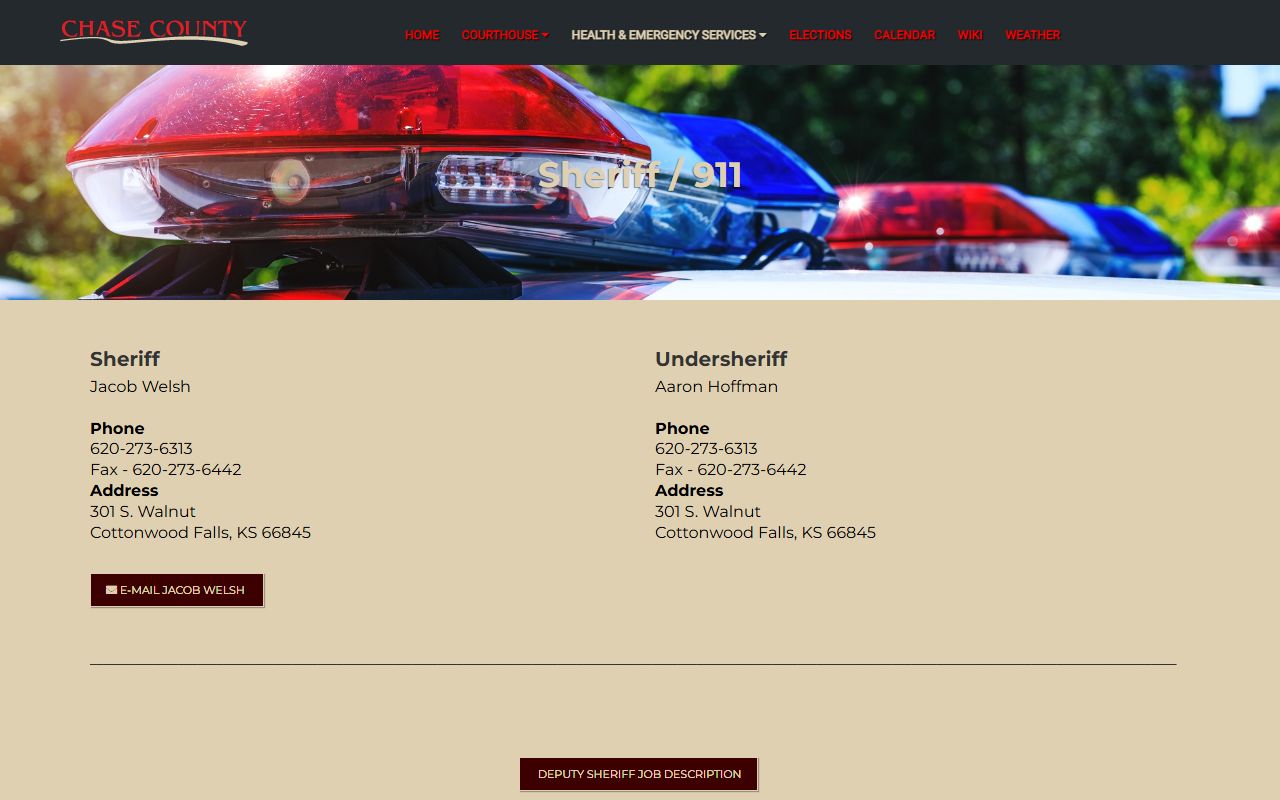
That page anchors local custody questions before a reader moves to state corrections, federal prison, or immigration detention systems.
The state locator source is separate. The captured KDOC KASPER search page shows why a Chase County jail search and a Kansas prison search are not the same task.
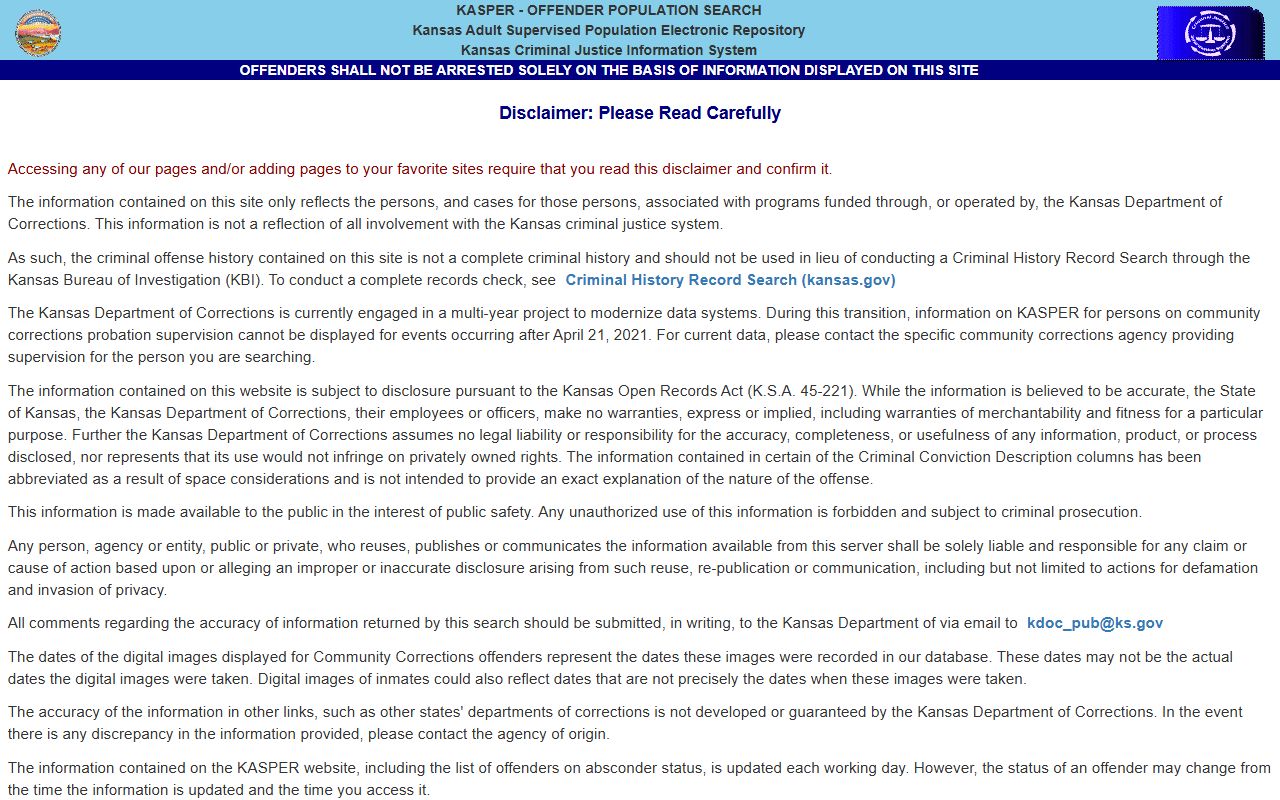
KASPER becomes most useful after a Chase County case results in a state sentence or KDOC supervision.
Chase County Detention Facilities
The Facility Map resolves to one local detention facility. The Chase County Detention Center is the primary jail, the sheriff-operated local custody site, and the facility identified by ICE as Chase County Jail. No KDOC prison, BOP institution, or separate ICE-owned detention center was found physically inside Chase County.
- Chase County Detention Center - county jail in Cottonwood Falls holding local arrestees, short-term jail inmates, city prisoners, agency holds, and immigration detainees under the ICE-listed facility role.
Chase County Inmate Population FAQ
How big is the Chase County inmate population?
An official current jail count was not found in accessible county sources. Research found news reporting that described the jail as a reported 148-bed facility, but that number was not located on an accessible official county capacity page.
Why can the jail population exceed local arrests?
The Chase County Detention Center also appears on ICE's detention-facility list. That means immigration detainees may be held in the same building as local jail inmates, even when they have no Chase County criminal case.
Where should a Chase County inmate search start?
Start with the Chase County Detention Center website or the detention phone line. If that does not locate the person, use KASPER for Kansas state custody, BOP for federal custody, ICE ODLS for immigration detention, and VINELink for notifications.
Can past Chase County inmate records be requested?
Yes, records may be requested through the sheriff under Kansas open-records law, but the agency may apply KORA exceptions for investigation records, private information, or records not required to be disclosed.
Public Record Search
Sponsored Results